
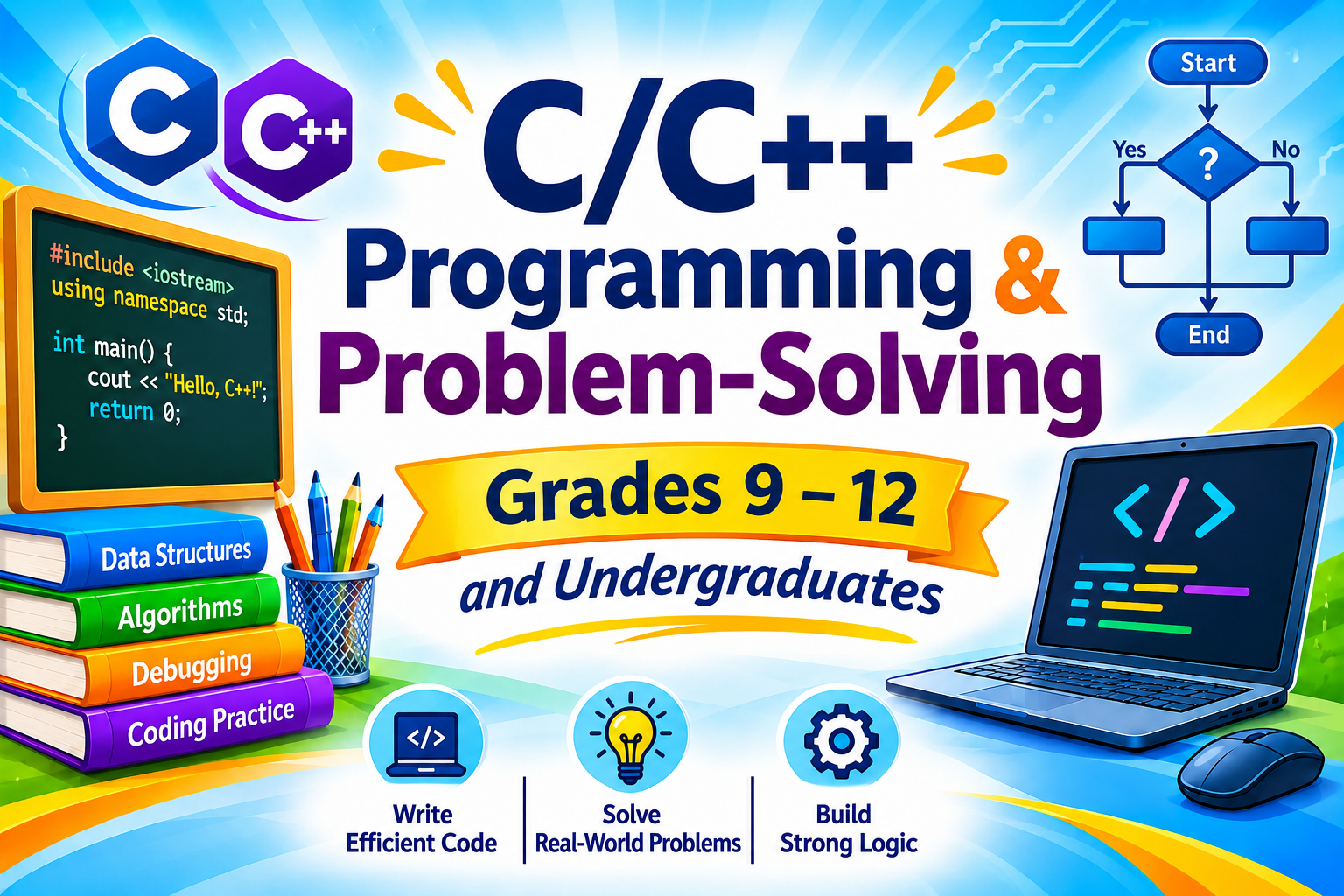
C/C++ Programming and Problem-Solving
Learn C and C++ programming through practical coding, problem-solving and hands-on projects. Master programming fundamentals, control structures, functions, arrays, pointers and object-oriented programming.
Teacher & owner Javid Parray
30 sessions · 1 hour per session
About this QSquad
The learners will be divided into three groups according to their education levels. Level 1 – School Programming Grades 9–10 - Programming fundamentals - Algorithms and flowcharts - Conditions and loops - Basic functions and arrays Level 2 – Senior Secondary Programming Grades 11–12 - C/C++ fundamentals - Functions and recursion - Arrays and strings - Pointers and structured programming Level 3 – Undergraduate Programming BCA / B.Sc. CS / B.Tech. - Advanced C programming - Pointers and dynamic memory allocation - Structures and file handling - Object-oriented programming - Practical programming projects # C/C++ Programming: From Fundamentals to Advanced Concepts Welcome to a comprehensive and practical journey into the world of computer programming! This QSquad is designed for students of Grades 9–12 and undergraduate learners who want to develop strong programming skills using C and C++. The programme begins with fundamental programming concepts and gradually progresses towards structured programming, advanced C concepts and object-oriented programming using C++. No previous programming experience is required. Concepts will be explained systematically through practical demonstrations, coding exercises and real-world problem-solving examples. ### What Will You Learn? **1. Programming Fundamentals** - Introduction to Programming Languages - Algorithms and Flowcharts - Structure of C and C++ Programs - Variables, Constants and Data Types - Input and Output Operations - Operators and Expressions **2. Decision-Making and Looping** - Conditional Statements - if, if-else and Nested if - switch Statement - for, while and do-while Loops - Nested Loops - break and continue Statements **3. Functions and Modular Programming** - Introduction to Functions - Function Declaration and Definition - Function Arguments and Return Values - Recursion - Scope and Lifetime of Variables **4. Arrays, Strings and Pointers** - One-Dimensional and Two-Dimensional Arrays - String Handling - Introduction to Pointers - Pointer Arithmetic - Relationship Between Arrays and Pointers **5. Advanced C Programming** - Structures and Unions - Enumerations and Typedef - Dynamic Memory Allocation - File Handling - Preprocessor Directives **6. Object-Oriented Programming with C++** - Introduction to OOP - Classes and Objects - Constructors and Destructors - Encapsulation and Abstraction - Inheritance - Polymorphism - Function and Operator Overloading ### Teaching Methodology - Concept-based explanations with practical examples. - Live coding and program demonstrations. - Step-by-step program development. - Hands-on programming exercises. - Debugging and error-solving activities. - Regular coding assignments and assessments. - Practical mini-projects. ### Learning Outcomes By the end of this programme, students will be able to: - Understand fundamental programming concepts. - Write, compile, execute and debug C/C++ programs. - Develop logical and computational thinking. - Implement functions, arrays, pointers and data structures. - Understand object-oriented programming principles. - Develop solutions to real-world computational problems. ### Teaching Approach My teaching approach focuses on building strong conceptual foundations and developing practical programming skills. Students will be encouraged to write code independently, analyse errors, experiment with solutions and develop confidence in programming. **Learn to Think. Learn to Code. Learn to Solve Problems!**
Teacher
Javid ParrayWhat you will learn
- 1. Understand fundamental programming concepts.
- 2. Write, compile, execute and debug C/C++ programs.
- 3. Develop logical and computational thinking.
- 4. Understand object-oriented programming principles.
Who this QSquad is for
- 1. Students of Grades 9–12 who want to learn programming and develop computational thinking.
- 2. Undergraduate students pursuing BCA, B.Sc. Computer Science, B.Tech. or related programmes.
- 3. Beginners interested in learning C and C++ from scratch.
- 4. Students preparing for school examinations, university assessments and programming practicals.
Entry requirements
- 1. Laptop or desktop computer.
- 2. Stable internet connection.
- 3. Basic computer operating knowledge.
- 4. C/C++ compiler or IDE such as Code::Blocks, GCC or Visual Studio.
- 5. Notebook for writing algorithms, dry runs and programming exercises.
Prerequisites
- 1. Basic computer literacy.
- 2. Fundamental mathematical knowledge.
- 3. Interest in programming and logical problem-solving.
- 4. Willingness to practise coding regularly.
- 5. No previous knowledge of C or C++ is necessary.
Sessions
Starts 2027-01-04 — 2027-02-02
- 1. Introduction to Programming
- 2. Algorithms and Flowcharts
- 3. Structure of C and C++ Programs
- 4. Variables, Constants and Data Types
- 5. Input, Output and Operators
- 6. Decision-Making Statements
- 7. Nested Conditions and Switch
- 8. Introduction to Loops
- 9. for, while and do-while Loops
- 10. Nested Loops and Patterns
- 11. Functions and Modular Programming
- 12. Function Arguments and Return Values
- 13. Recursion
- 14. One-Dimensional Arrays
- 15. Two-Dimensional Arrays
- 16. Strings and String Operations
- 17. Introduction to Pointers
- 18. Pointer Arithmetic
- 19. Structures and Unions
- 20. Dynamic Memory Allocation
- 21. File Handling in C
- 22. Introduction to Object-Oriented Programming
- 23. Classes and Objects
- 24. Constructors and Destructors
- 25. Inheritance
- 26. Polymorphism
- 27. Function and Operator Overloading
- 28. Encapsulation and Abstraction
- 29. Practical Programming Project
- 30. Final Coding Challenge and Assessment
Members & seat availabilityMembers & seat availabilitySigned in, you see who is in this QSquad: its teacher and members see everybody in it, and anybody else sees only adults with a public profile. Tap a face to view their profile or send a message.
It runs only if the minimum is reached when joining closes. If not, it is cancelled, nothing is charged and every hold is released.
Policies
Joining and leaving close exactly 24 hours before the scheduled start of the first session. At this cutoff, the enrolled student count is final. If minimum enrolment is reached, the total tuition value — the value per session multiplied by the number of sessions — is divided equally among enrolled students and deducted from their Q-Wallets, together with applicable additional fees, tax and optional donations. If minimum enrolment is not reached, the QSquad is cancelled automatically and all reserved funds are released.
Students who leave before the cutoff receive a full release of their reserved funds. If the QSquad is cancelled because minimum enrolment is not reached, no payment is collected. After the cutoff, students cannot leave through the normal enrolment process. Teacher or platform cancellations trigger refunds for undelivered sessions and any refundable associated fees.
Common questions
- How long is each session?
- 1 hour. Every session in this QSquad has that length, set when it was created, and it does not change once anyone has joined.
- What will I pay in total?
- The whole group pays 200 Creds per session across 30 sessions, 6,000 Creds in all, shared equally by the students enrolled when joining closes: from 750 Creds each if every seat is taken, to at most 1,500 Creds each at the minimum of 4. Your share can only go down as more people join. Any tax and optional extras are shown before you confirm.
- What happens if the minimum enrolment is not reached?
- This QSquad needs 4 students. If the minimum is not reached when joining closes, the QSquad is cancelled, nothing is charged and your hold is released.
- Can more students be added later?
- No. Capacity is fixed at 8 and does not change once anyone has joined.
Capacity, schedule & pricing
- QSquad value per session
- 200 Creds
- Total QSquad valueTotal QSquad valueValue per session × 30 sessions, shared equally by the students enrolled at the cutoff.
- 6,000 Creds
- Your estimated tuitionYour estimated tuitionIf it runs with the 0 enrolled now (or the minimum, if fewer).
- 1,500 Creds
- Most you can payMost you can payThe share at the minimum enrolment of 4; fewer cancels it and charges nothing.
- 1,500 Creds
Joining closes inJoining closes inJoining and leaving are unavailable after this.44d 11h 58m
Tuition by number of students
| Students | Tuition each |
|---|---|
| 1 | Does not meet minimum enrolment |
| 2 | Does not meet minimum enrolment |
| 3 | Does not meet minimum enrolment |
| 4 | 1,500 Creds |
| 5 | 1,200 Creds |
| 6 | 1,000 Creds |
| 7 | 858 Creds |
| 8 | 750 Creds |
Plus 5% tax on tuition and fees, added when you join.
It runs only if the minimum is reached when joining closes. If not, it is cancelled, nothing is charged and every hold is released.
Your seat is held once you join. If the minimum is not reached when joining closes, the QSquad is cancelled, nothing is charged and your hold is released.